No Candlelight, No Kneeling
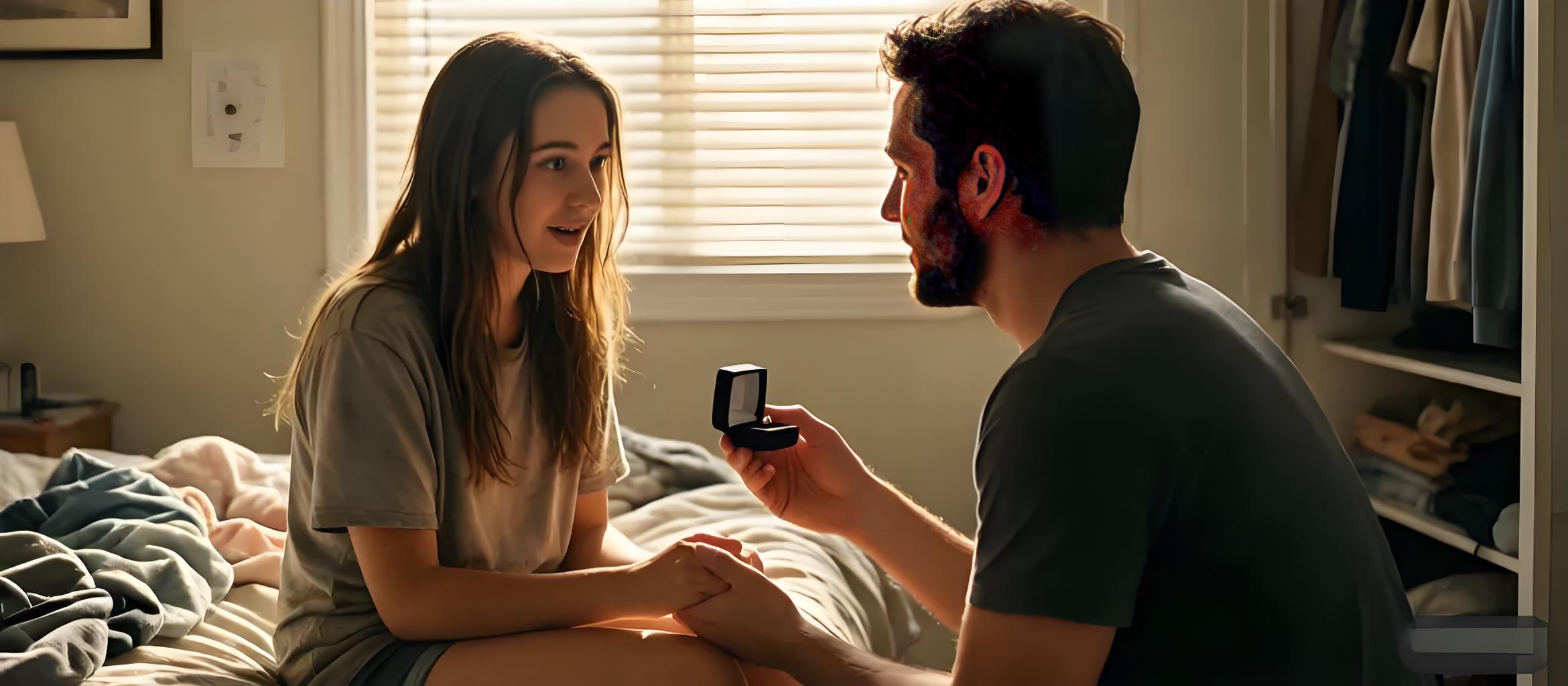
In the landscape of romance fiction, proposals are often grandiose affairs. Candlelit dinners. Orchestrated surprises. Speeches that bring tears to the eyes of everyone in the room. Wrapped in Chains does something radically different. The proposal happens in a quiet bedroom, with Breanna sitting on the edge of the bed in one of Chains’s old t-shirts, her hair still damp from a shower, arguing about nursery paint colours.
It wasn’t planned. Not in the romantic sense. No candles. No staged moment. No audience.
This is a deliberate choice by the author. Chains is not a man for spectacle. He is a man for action. And the proposal, stripped of all performance, is therefore more authentic than any grand gesture could be.
The Ring That Fit
He reaches into the top drawer of the dresser. A small black box. He opens it. The ring is simple—a two-carat pear-shaped solitaire with a plain gold band. Solid. Intentional. The description mirrors the man himself.
It fit. Of course it did. He’d measured one of her old rings weeks ago. Without telling her.
This detail is quietly devastating. Chains, who has been accused of not paying attention, of being too wrapped up in his own world, measured her ring in secret. He planned this. He thought about it. He prepared. And he did it without fanfare, without expectation of praise. He just did it because he wanted to do it right.
The Question She Had to Ask
Before she says yes, Breanna asks the question that has haunted their entire relationship:
“This isn’t because I’m pregnant, right?”
It is a fair question. They have a daughter on the way. Chains is a man of honour, in his own way. Would he marry her out of obligation? Would he confuse responsibility with love?
His answer is immediate and unflinching:
“You think I’d marry you out of obligation?”
There is no hesitation. No defensiveness. He is genuinely offended by the suggestion—not because he is insulted, but because it diminishes what he feels. He is not marrying her because she is carrying his child. He is marrying her because she is her.
The Most Important Line
When Breanna asks if he is going to try to cage her—the central fear of their relationship—he does not promise perfection. He does not say “I will never control you again.” He says something far more honest:
“I’m going to try not to.”
This is the line that makes the proposal believable. Chains is not a different man than he was at the beginning of the novel. He still has possessive instincts. He still wants to protect and control. But he is aware of it now. And he is committed to fighting that part of himself.
Honest. Not perfect. Trying.
Breanna’s response is perfect: “That’s the most romantic thing you’ve ever said.” And she means it. Because she has learned, over the course of their relationship, that easy promises are worthless. What matters is the willingness to do the hard work. To try, even when trying is exhausting.
Standing Beside, Not Owning
Chains does not kneel. This is a choice that could read as arrogance, but in context, it reads as something else. He is not asking for her submission. He is not performing a traditional gesture of masculine dominance. He stands in front of her, eye to eye, and says:
“I don’t need to own you. But I want to stand next to you.”
This is the evolution of his character. At the beginning of the novel, he wanted to own her. He wanted to claim her, to mark her, to make sure everyone knew she was his. Now, he wants to stand beside her. The difference is subtle but profound. Ownership is hierarchical. Standing beside is partnership.
The Yes That Was Never in Doubt
She says yes. Not dramatically. Not tearfully. Just yes. And he nods once. Decision made.
Then he pulled her into him. His hand spread over her lower back. The other came up to cradle the back of her head. He pressed his forehead against hers.
This is their version of intimacy. Not a sweeping kiss, but a quiet, grounding contact. Forehead to forehead. Breath mingling. A moment of stillness before the chaos of wedding planning and parenthood and life.
Personal Reflection
I have read many fictional proposals, and most of them blur together. The grand gestures, the heartfelt speeches, the tears and applause. What I will remember about Chains’s proposal is its quietness. Its lack of performance. Its honesty.
The line “I’m going to try not to” is not romantic in the conventional sense. But it is romantic in the truest sense: it is a promise rooted in self-awareness, in humility, in the recognition that love is not about being perfect but about being present. It is the kind of promise that, if kept, actually means something.
And as a female reader, that is the kind of proposal I want to read about. Not the fairy tale. The real thing.